Universities in all fifty states are exempt from paying property taxes due to their educational purpose.
These are "purposes that the federal government has long recognized as fundamental to fostering the productive and civic capacity of its citizens," according to the Association of American Universities.
However, universities’ tax-exempt status has been a point of contention across the political aisle.
But what happens when universities own much of the neighborhood?
Will UChicago Need to Pay Property Tax?
By Jinny Kim
In September this year, Chicago Mayor Brandon Johnson's Financial Future Task Force,
an independent group of 24 civic leaders convened to address Chicago's $1.15 billion
budget deficit, published its
first report.
One of the ideas was to collect annual voluntary payments of up to $52 million from tax-exempt institutions,
including $20 million from educaional institutions, although with caution about possible opposition.
Voluntary payments from universities is something that the
Chicago Teachers Union has been
demanding the city for years as well.
But how much property do universities own in Chicago? How much would they pay if they weren't tax-exempt?
Scroll below to find out.
University of Chicago
DePaul University
Loyola University
Northwestern University
University of Illinois
These are properties in Chicago that five major universities own.
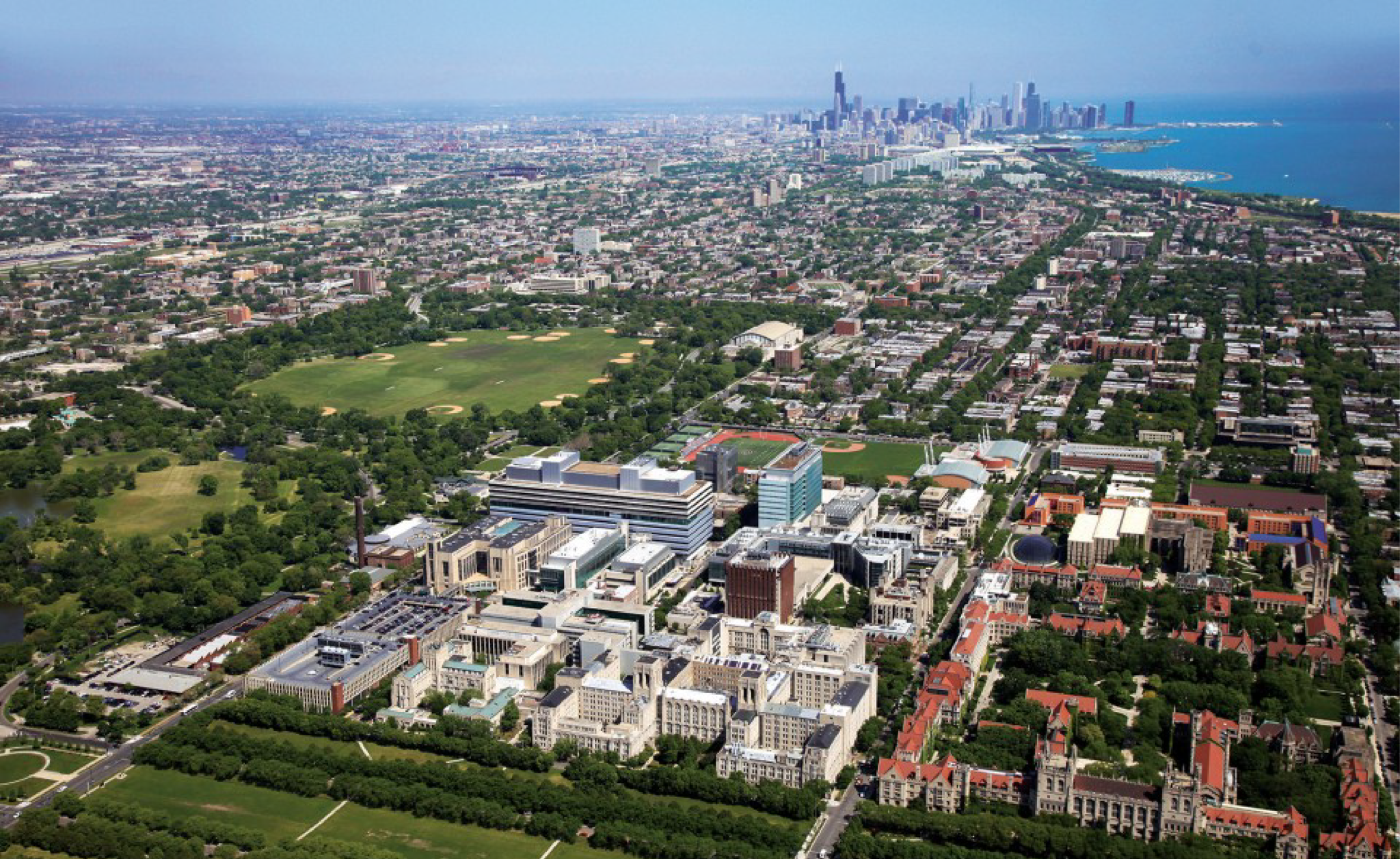
They own close to 1,500 properties, concentrated in Hyde Park and Near West Side.
In particular, the University of Chicago has had a significant influence on Hyde Park.
About 80 percent of its properties are tax-exempt, according to the author's calculations.
Most of the university's properties are school buildings.
But they also own some mixed-use and residential units.
On 55th St, Campus North Parking greets those entering campus.
But this building is not only a 4-level parking garage.
It also includes Roux, a restaurant, and Seven Ten Social, a bar with a bowling alley.
Across the street is a four-level apartment building that has been tax-exempt for at least the last 20 years.
If UChicago was a typical residential property owner, it would have paid about $8 million in property taxes in fiscal 2024, according to the author’s calculations.
This is likely a significant underestimate as the figure is based on the average land value of neighborhood parcels,
and it is difficult to know all the properties that the university owns.
Chris Berry, a professor at UChicago’s Harris School of Public Policy, says that what is important is how much the university is living up to its tax-exempt status.
“There's a reason why certain nonprofits are exempted from taxes, and the reason is that we think they provide valuable services to the public,” he said.
“So as long as they're doing that, I think they've satisfied their obligations.”
"I do think the counterfactual is challenging, because there are so many spillovers that are generated by the university in terms of the valuation of other property in its vicinity."
For instance, the UChicago Medicine has invested more than $715 million in community benefits in fiscal 2024, such as helping community organizations hire health workers.
However, the impacts of UChicago on the surrounding neighborhood are not without scrutiny.
Source: University of Chicago
In the book In the Shadow of the Ivory Tower, author Davarian Baldwin argues that universities, such as UChicago, have a significant impact on the economic and social landscape of the neighborhood.
“Few understand higher education’s national role in the devastating history of demolition and displacement of stable communities during the Urban Renewal period," he said.
"When neighborhoods are targeted for campus expansion, the people who live there face the enduring trauma of losing their homes and the physical disruption of their cultural ties."
Baldwin points out community institutions were replaced with retail chain such as Starbucks, Chipotle and LA Fitness.
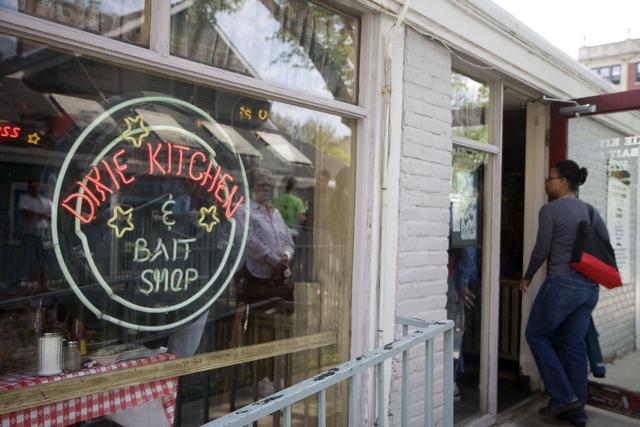
One of them was the Dixie Kitchen & Bait Shop, which closed after UChicago declined to renew her lease, according to the owner's interview with the Hyde Park Herald.
Source: Eric Guo
The impact of property tax exemption is more acute in college towns where the majority of a district’s properties are owned by a tax-exempt entity.
However, universities in Chicago are still using public services that are financed by property taxes.
“Universities still use public services like fire department and public transportation,” said Eric Langowski, a senior data scientist at UChicago’s Mansueto Institute for Urban Innovations.
“There's a first-order cost [that] the city has to provide more services to service the university directly.”
In some cities, universities contribute through a voluntary payment program called Payment in Lieu of Taxes (PILOT).
In 2023, four colleges in Providence, including Brown University, struck an agreement with the city to pay more than $200 million over the next 20 years.
Harvard University has paid the city of Cambridge $40 million in PILOT in the last 10 years.
In Chicago, community organizations, such as Grassroots Collaborative, are advocating for universities in the city to also participate in this program.
“Now, more than ever, we need to see progressive revenue options, and we see the PILOT program as one of those ways of really achieving that,” said Jesse Hoyt, executive director of ONE Northside.
For now, the discussion remains open, and it is unclear how the city will move forward with voluntary payments from universities.
"The main thing is that there are direct costs incurred by the government to serve the university still, and I think at minimum, those should be considered as something that should be paid," Langowski said.
"But it's a political conversation, ultimately, is how the property taxes play out with universities and other nonprofits."
Methodology
1. For the property analysis, we analyzed datasets from Cook County's Assessor's Office.
The analysis filtered for parcels owned by the universities based on their names.
Lake Park Associates was also included for UChicago as it is an identified subsidiary that
acquires and manages property on behalf of the university.
We used the parcel addresses dataset to identify parcels,
and the property tax-exempt parcels dataset to identify tax-exempt parcels.
2. The analysis estimated the universities' property value by calculating the median land value per square footage
in neighborhoods that the universities own properties in from the assessed value dataset.
Here, we are referring to the assessors' neighborhoods which are intended to represent homogenous housing submarkets, not community areas.
The analysis filtered for parcels that have Board of Review certified land value that exceeds $100 to exclude parcels
that may be too small. We also limited the data to tax year 2024. We multipled the assessed value by 10 to approximate the market value,
and used 1.5 percent to estimate the property tax amount, which was Chicago’s 2022 effective tax rate on median valued residential propertie,
according to the Civic Federation.
Note that as of 2017, owner names in the Cook County Assessor's Property Tax-Exempt Parcels dataset are no longer being regularly updated.
This could potentially mean some parcels are misclassified as being owned by a university even after its sale.